
Comparing Skincare Products by Claims Instead of Function Causes Confusion
Skincare products are often compared by claims rather than function. This article explains how to compare products properly without getting misled.
PRODUCT COMPARISONS
1/10/20262 min read
Why product comparisons often feel overwhelming
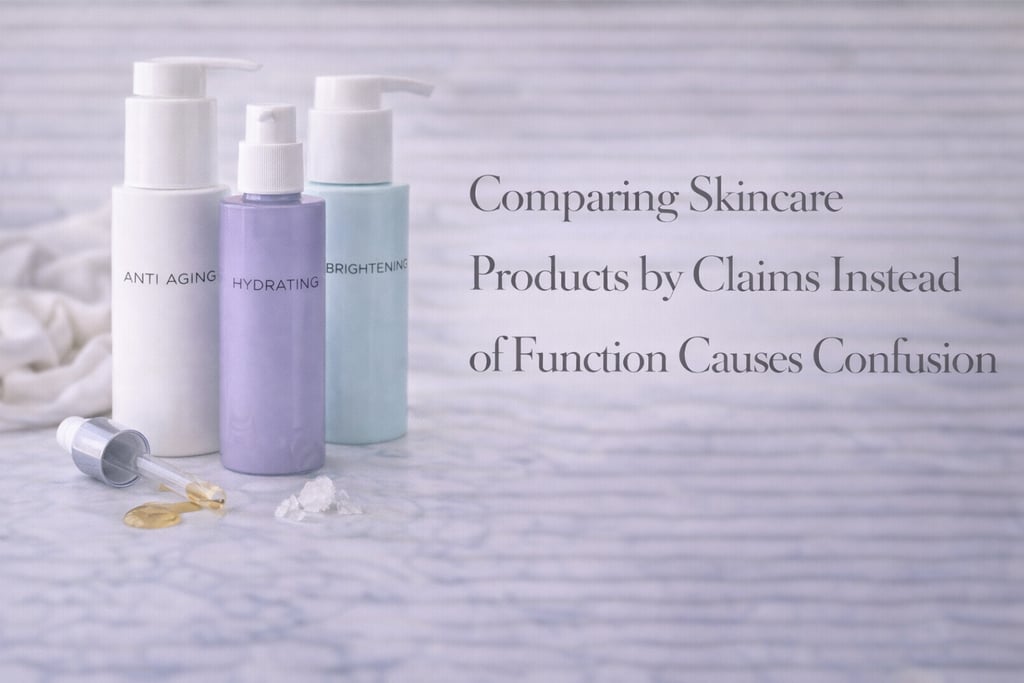
Many people compare skincare products by reading the front label. Brightening. Hydrating. Anti aging. Repairing.
These words sound helpful, but they are vague. They describe outcomes, not function.
When products are compared this way, it becomes difficult to understand what actually differs between them.
Confusion grows because two products can claim the same result while working very differently on the skin.
Claims describe promises, not mechanisms
A claim explains what a product hopes to deliver.
Function explains how the product works.
Two products can both claim to hydrate the skin. One may add water. The other may seal moisture that is already there.
Without understanding function, comparisons remain shallow.
Effective choices come from understanding how a product behaves, not what it promises.
Why similar claims produce different results
Skin responds to mechanisms, not marketing.
If a product attracts water, the skin will feel plumper. If it only seals, the skin may feel smoother but still dehydrated underneath.
Products with similar claims can feel very different depending on formulation.
Comparing outcomes without understanding process leads to mismatched expectations.
The role of formulation over ingredients
Ingredient lists matter, but formulation matters more.
Two products can contain the same ingredients in different concentrations or delivery systems.
This affects absorption, tolerance, and performance.
Comparing ingredient lists alone does not explain why one product works better for you than another.
Why price comparison adds noise
Price is often used as a shortcut for quality.
Higher price does not guarantee better function. Lower price does not mean weaker performance.
Cost is influenced by branding, packaging, and marketing.
Comparing price instead of function adds confusion rather than clarity.
How skin type changes product comparison
The same product behaves differently on different skin types.
A product that feels nourishing on dry skin may feel heavy on oily skin.
Comparing products without considering skin type leads to misleading conclusions.
Context matters.
Why reviews can mislead comparisons
Reviews reflect individual experience.
Skin type, climate, routine, and expectations vary widely.
A product praised for being gentle may feel ineffective to someone else.
Reviews provide perspective, not certainty.
Using reviews as one data point is more helpful than using them as a verdict.
Comparing textures instead of performance
Texture is often mistaken for effectiveness.
Light textures feel active. Thick textures feel nourishing.
Neither guarantees better results.
Texture affects comfort and preference, not outcome.
Performance depends on function and consistency.
Why time matters in comparison
Skincare results take time.
Comparing products after a few uses rarely shows real differences.
Early reactions often reflect adjustment, not effectiveness.
Longer use provides clearer insight.
Comparing products used in different routines
Products do not exist in isolation.
How a product performs depends on what comes before and after it.
Comparing products without considering routine context leads to flawed conclusions.
Compatibility affects outcome.
Why fewer comparisons improve decisions
Constant comparison delays commitment.
Switching products frequently prevents the skin from adapting.
Stability allows results to develop.
Choosing thoughtfully and sticking with a product often yields better insight than endless comparison.
How to compare products more effectively
Effective comparison focuses on role.
Is the product meant to add water. Seal moisture. Exfoliate. Calm.
Understanding role clarifies choice.
Comparing by role simplifies decision making.
When two products truly overlap
Some products do overlap in function.
In these cases, choosing based on tolerance, texture preference, and consistency matters more than marginal differences.
There is rarely a perfect option.
There is often a good enough option.
Why clarity reduces frustration
When products are chosen by function, expectations align better with results.
Skin reactions feel more predictable.
Routines become easier to manage.
Clarity reduces frustration.
Final thoughts
Comparing skincare products by claims creates confusion.
Function explains performance better than promises.
Understanding how products work leads to better choices and more consistent results.
Clarity improves skincare more than comparison ever will.