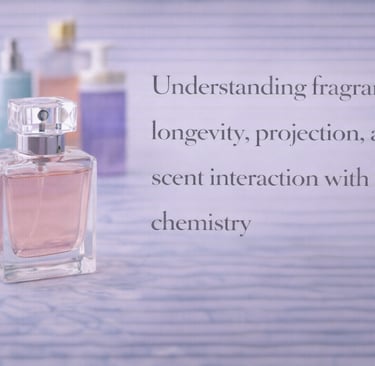
Understanding fragrance longevity, projection, and scent interaction with lifestyle and body chemistry
Perfume longevity and projection depend on interaction with body chemistry, skin moisture, climate, placement, and micro-behaviors. Learn evidence-based best practices for lasting scent without oversaturation.
FRAGRANCES ON A BUDGET
1/10/20263 min read

how fragrance molecules interact with skin
Perfume is a blend of volatile and less volatile organic compounds formulated to evaporate at different rates. When sprayed on skin, fragrance does not simply “sit.” It interacts with:
surface moisture
skin’s natural oils
temperature
ambient humidity
These interactions influence how molecules evaporate, which in turn shapes scent evolution — from top notes (most volatile) to middle notes and then base notes (least volatile). Scent is therefore an emergent property of chemistry, physiology, and environment combined.
Professional perfumery texts describe these stages as part of the olfactory experience. The science of fragrance development acknowledges that these stages are part of both creation and wear. (Perfumer’s World Journal, “Fragrance structure and evolution”)
why fragrance lasts longer on some skin than others — body chemistry
Body chemistry impacts how perfume behaves. Key factors include:
sebaceous activity — oilier skin holds fragrance molecules longer because oils slow evaporation
hydration level — hydrated skin provides more substrate for scent to anchor to
skin pH — slight variations in acidity change how fragrance interacts at the molecular level
temperature — body heat increases volatility of molecules, sometimes making scent feel stronger earlier but fade sooner
These are not myths. Biochemical studies show that skin composition — including lipid levels and pH — affects topical product behavior. Perfume is no exception.
climate, humidity, and fragrance behavior
Climate plays a major role in how long perfume lasts and how it projects.
humid environments
fragrance molecules linger on the surface longer
evaporation rate slows
base and middle notes can feel prominent for hours
arid environments
rapid evaporation
top notes fade quickly
residual scent may be weak on the surface
temperature extremes
heat increases volatility
cold slows evaporation and can make base notes dominant
Understanding these effects helps manage expectations and adjust application accordingly.
projection vs longevity — the difference explained
Projection and longevity are often conflated, but they are not the same.
projection refers to how far a scent travels from the skin
longevity refers to how long a scent remains detectable on the skin
Projection depends on heat, placement, and concentration of volatile compounds. Longevity is governed by base notes and overall formulation strength.
A fragrance can project strongly at first but fade quickly, or remain close to the skin longer without traveling far — both are valid experiences depending on composition.
strategic placement to influence scent experience
Applying fragrance on pulse points (such as wrists, neck, behind ears) increases projection because these areas are slightly warmer. However:
too many pulse points sprayed can overwhelm in tight spaces
targeted placement tends to make scent evolve more naturally without saturation
Some professionals recommend focusing on one or two spots rather than multiple applications for balanced evolution throughout the day.
hydration and barrier prep improve fragrance longevity
Skin that is well hydrated holds fragrance better. Hydration creates a slightly “stickier” surface for volatile molecules to adhere to.
Best practices include:
moisturizing before fragrance application
avoiding alcohol-heavy toners immediately before perfume
choosing fragrance silhouettes that match skin behavior (fresh for humid, deeper for dry climates)
This does not alter the fragrance itself, but it alters the medium with which it interacts.
common habits that shorten perceived longevity
Patterns that make fragrance seem to fade faster include:
rubbing wrists together (accelerates evaporation)
applying immediately after hot showers (heat spikes volatility)
layering multiple fragrances (creates molecular confusion)
overapplication (leads to rapid early burnout)
Each of these affects how molecules disperse and how the brain perceives them over time.
the role of context and sensory adaptation
When you smell the same scent over and over, your brain acclimates and essentially “tunes out” familiar signals. This is a neurological phenomenon known as olfactory adaptation.
This does not mean the fragrance disappeared. It means your sensory system deprioritized it. Others may still perceive the scent clearly.
This explains why people around you can smell a fragrance you no longer notice.
layering products — best practices and pitfalls
Layering body products with fragrance can help longevity, but only if they are compatible:
lightly scented moisturizers that share complementary notes
unscented oils that help trap fragrance molecules
avoid layering conflicting notes that crowd or distort the headspace
Layering should enhance, not complicate, fragrance performance.
storage matters for long-term scent integrity
Fragrance stability degrades under:
heat
light exposure
humidity
frequent temperature swings
Storing perfume upright, in a cool, dim environment preserves its integrity. Poor storage changes molecular distribution, which subtly alters how the fragrance unfolds on skin.
addressing common fragrance “problems” with nuance
Instead of blaming the perfume, consider these factors:
scent seems weak — might be working, but olfactory adaptation is reducing perception
scent seems strong at first, then disappears — volatility profile of top notes
scent feels different on another day — climate, skin state, or application context changed
These are normal and expected variables, not manufacturing flaws.
FAQ
Does humidity affect how perfume smells
Yes — higher humidity slows evaporation and often makes scent linger longer, especially base notes.
Why do some fragrances smell different on me than on others
Differences in skin oil, pH, hydration, and body temperature alter how molecules evolve.
Can application technique change longevity
Yes — placement, skin prep, and avoidance of friction all influence how long a fragrance lasts on skin.
conclusion
Fragrance longevity and projection are not fixed. They depend on complex interactions between body chemistry, environment, and application. Understanding these influences helps set realistic expectations and supports better fragrance experiences.