
Why comparing beauty products by price or hype leads to poor decisions
Comparing beauty products by price or popularity often leads to confusion. Learn how to compare by function, formulation, and real performance instead.
PRODUCT COMPARISONS
1/10/20262 min read
why most beauty comparisons fail
Beauty products are often compared using shortcuts. Price. Packaging. Online popularity. Brand reputation.
These comparisons feel efficient, but they rarely reflect how products actually behave on skin or hair.
Two products can appear similar and perform very differently. Others can look different and behave nearly the same.
Effective comparison requires shifting focus away from surface level signals.
claims describe intent, not behavior
Front label claims are marketing language, not performance guarantees.
Examples of common claims:
hydrating
repairing
brightening
strengthening
balancing
These words do not explain how the product works.
A product can claim hydration while only sealing existing moisture. Another may add water but not seal it. Both are “hydrating” in marketing language.
Without understanding mechanism, comparisons remain shallow.
function is the most important comparison point
Function answers one question. What does this product actually do on contact.
Core functions include:
adding water
sealing moisture
exfoliating surface cells
calming inflammation
removing buildup
depositing conditioning agents
Products with the same function often perform similarly, even when price and branding differ.
Products with different functions may share claims but behave very differently.
ingredient lists need context
Ingredient lists show what is present, not how it behaves.
Two products with similar ingredient lists can perform differently due to:
ingredient concentration
order of ingredients
delivery system
interaction between ingredients
Ingredient lists are useful, but they do not tell the full story.
Formulation determines performance.
formulation matters more than individual ingredients
Formulation controls:
absorption rate
skin tolerance
stability
texture
consistency over time
A well formulated product with fewer ingredients often outperforms a complex formula with poor balance.
Comparing products ingredient by ingredient misses this context.
texture is preference, not performance
Texture strongly influences perception.
Light textures feel active. Thick textures feel nourishing.
Neither guarantees better results.
Texture affects comfort and compliance, not biological outcome.
Comparing by texture alone leads to preference based decisions, not performance based ones.
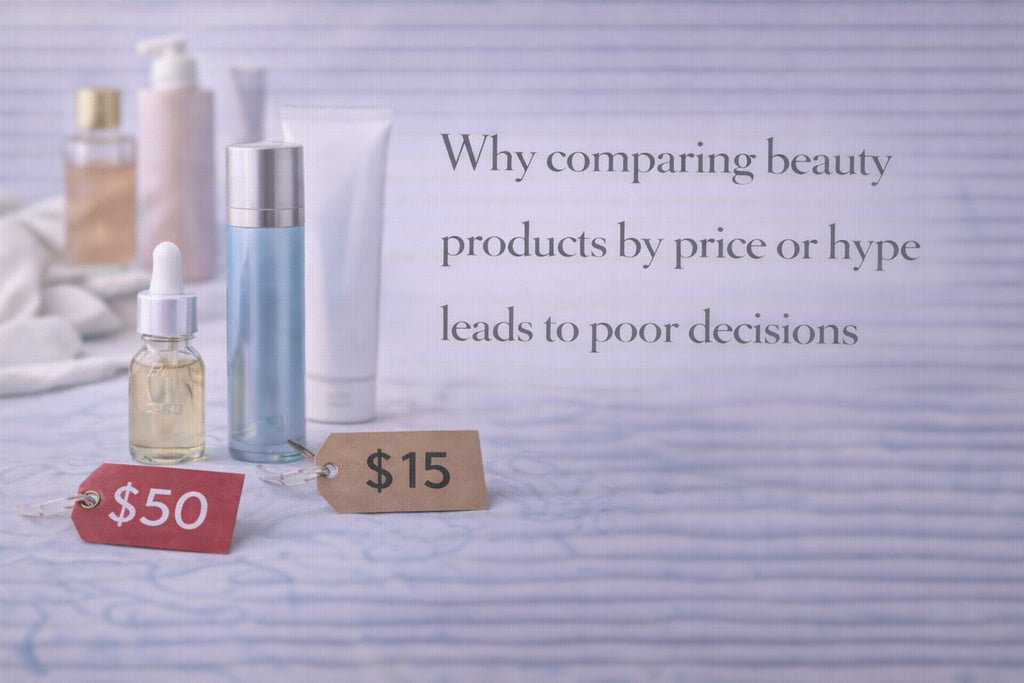
price adds noise to comparison
Price reflects many factors unrelated to function:
branding
packaging
retail placement
marketing spend
Higher price does not imply better formulation. Lower price does not imply lower effectiveness.
Price should be evaluated after function, not before.
reviews offer anecdotes, not consensus
Reviews reflect individual experiences.
Variables include:
skin or hair type
environment
routine compatibility
expectations
A product praised for gentleness may feel ineffective to someone else. A product praised for strength may irritate another person.
Reviews provide perspective, not certainty.
routine context changes product performance
Products do not work in isolation.
Performance depends on:
what comes before
what comes after
frequency of use
overall routine balance
Comparing products without considering routine context leads to misleading conclusions.
Compatibility often matters more than product strength.
when two products truly overlap
Some products genuinely overlap in function.
In those cases, differences often come down to:
tolerance
texture preference
ease of consistent use
cost efficiency
There is rarely a single “best” option. There are many adequate ones.
how to compare products more accurately
Effective comparison follows this order:
Identify the primary function
Confirm routine compatibility
Consider formulation quality
Evaluate tolerance over time
Factor in price and availability
This approach reduces impulse purchases and improves satisfaction.
why fewer comparisons improve outcomes
Constant comparison encourages frequent switching.
Switching prevents adaptation and masks results.
Stability reveals performance.
Often, choosing one reasonable option and using it consistently provides clearer insight than endless comparison.
common comparison traps to avoid
equating popularity with performance
assuming expensive equals better
judging within days instead of weeks
layering multiple similar products to “test” them
These behaviors create confusion rather than clarity.
FAQ
Why do two products with the same claims feel different
Because claims describe intent, not formulation behavior or delivery.
Is it better to compare by ingredients or reviews
Neither alone is sufficient. Function and formulation provide better context.
Can budget products perform as well as expensive ones
Yes. When function and formulation align, price becomes less relevant.
conclusion
Comparing beauty products by price, hype, or claims leads to frustration.
Function explains performance better than marketing language.
Understanding how products behave within a routine leads to better decisions and steadier results.