
Why Some Beauty Tools Help and Others Just Irritate Your Skin
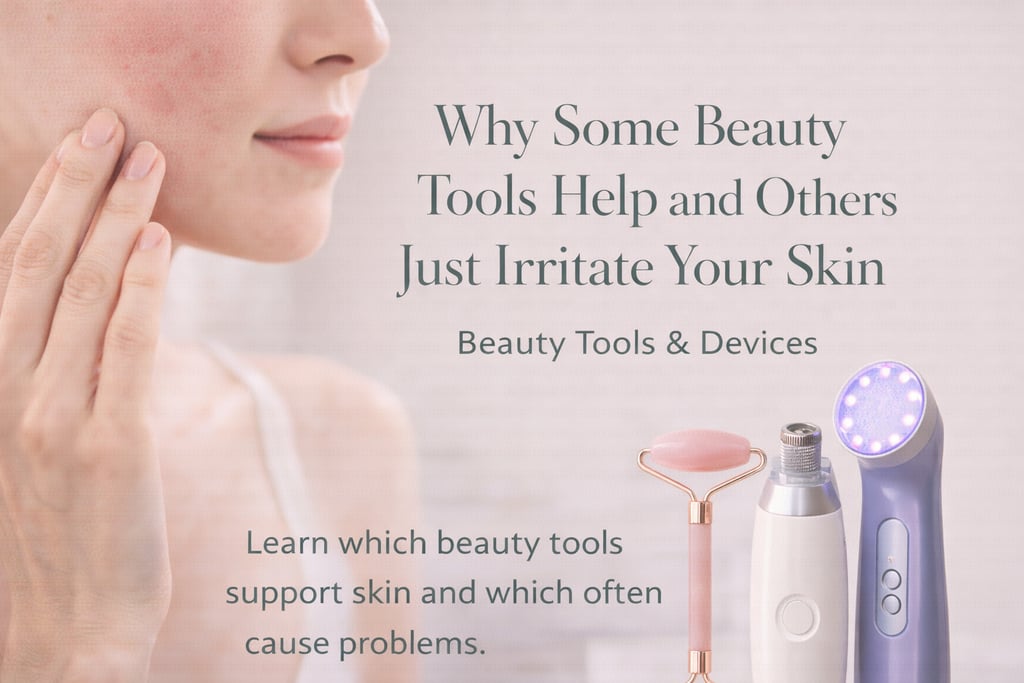
Beauty tools can improve skincare or cause irritation depending on how they are used. This article explains which tools help and which ones often cause problems.
BEAUTY TOOLS & DEVICES
1/8/20263 min read
Why beauty tools are confusing for many people
Beauty tools are everywhere now. Rollers, brushes, light devices, sculpting tools. Some people swear by them. Others give up after irritation or no results.
The confusion comes from expectations. Beauty tools are often treated as solutions instead of support.
Most tools are not harmful by design. Problems usually come from how often they are used, how much pressure is applied, or how many tools are layered together.
Understanding what tools can realistically do helps prevent damage and disappointment.
What beauty tools are actually meant to do
Beauty tools are designed to support the skin, not replace skincare products.
They can help cleanse more thoroughly. They can help products spread more evenly. They can reduce temporary puffiness. They can encourage relaxation.
They do not permanently change skin structure. They do not erase wrinkles. They do not fix chronic skin conditions.
When tools are seen as helpers instead of fixes, they work better.
Cleansing tools and irritation
Cleansing tools are one of the most common sources of irritation.
When used gently and occasionally, they can help remove buildup and sunscreen residue. When used daily with pressure, they strip the skin barrier.
Skin does not need to be scrubbed to be clean. Overcleansing weakens protection and increases sensitivity.
Cleansing tools should feel mild. If the skin feels tight or sore afterward, the tool is doing too much.
Mechanical exfoliation and the skin barrier
Many beauty tools exfoliate the skin, even if that is not their main purpose.
Exfoliation removes dead skin cells. Too much exfoliation removes protection.
When the barrier is damaged, the skin reacts more easily to products, heat, and friction.
Exfoliation should be limited. Skin improves when it has time to rebuild itself.
Facial rollers and gua sha tools
Facial rollers and gua sha tools are often misunderstood.
They do not sculpt the face permanently. They do not change bone structure. Their effects are temporary.
What they can do is reduce puffiness, support gentle lymph movement, and help products glide smoothly.
These tools work best with light pressure. Pushing harder does not increase benefits. It increases irritation.
Used gently, they are generally safe for most skin types.
Cooling tools and inflammation
Cooling tools work through temperature, not force.
Cold reduces inflammation and constricts blood vessels temporarily. This can calm redness and puffiness.
The effects are short lived but useful. Cooling tools are best used for comfort rather than transformation.
They should never be applied to damaged or broken skin.
Electrical and light based devices
Devices that use light or electrical stimulation require patience.
Results are subtle and gradual. They depend on consistent use over time.
These tools are not replacements for professional treatments. They can support skin health when used correctly.
Overuse or incorrect use increases sensitivity. Instructions matter.
More sessions do not mean faster results.
Why more tools often make skin worse
Many people use multiple tools in one routine. This overloads the skin.
Each tool adds stimulation. Together, they can push the skin past its tolerance.
Skin responds best to one change at a time. When irritation appears, it is easier to identify the cause.
Simple routines reduce risk.
Who benefits most from beauty tools
Beauty tools work best for people with stable skin and consistent routines.
They are helpful for those who enjoy slow improvements and self care rituals.
They are less suitable for reactive or compromised skin.
Skin health should come first. Tools are optional.
How to introduce a beauty tool safely
Any new tool should be introduced slowly.
Use it once or twice a week at first. Pay attention to how the skin responds over several days.
Redness, burning, or breakouts are signs to pause.
Skin feedback matters more than schedules.
When to stop using a tool
A tool is not worth using if it causes discomfort.
Persistent redness, increased sensitivity, or breakouts mean the skin barrier is under stress.
Stopping early prevents long term damage.
There is no benefit in pushing through irritation.
Setting realistic expectations
Beauty tools improve how skin feels more than how it looks.
They can support circulation and comfort. They can make routines feel more intentional.
They cannot replace sunscreen, cleanser, or moisturizer.
Tools work best when expectations stay realistic.
Final thoughts
Beauty tools are not useless. They are also not essential.
Used carefully, they can support skin health and make routines more enjoyable.
Used aggressively, they cause irritation and setbacks.
Healthy skin improves through patience, not pressure.