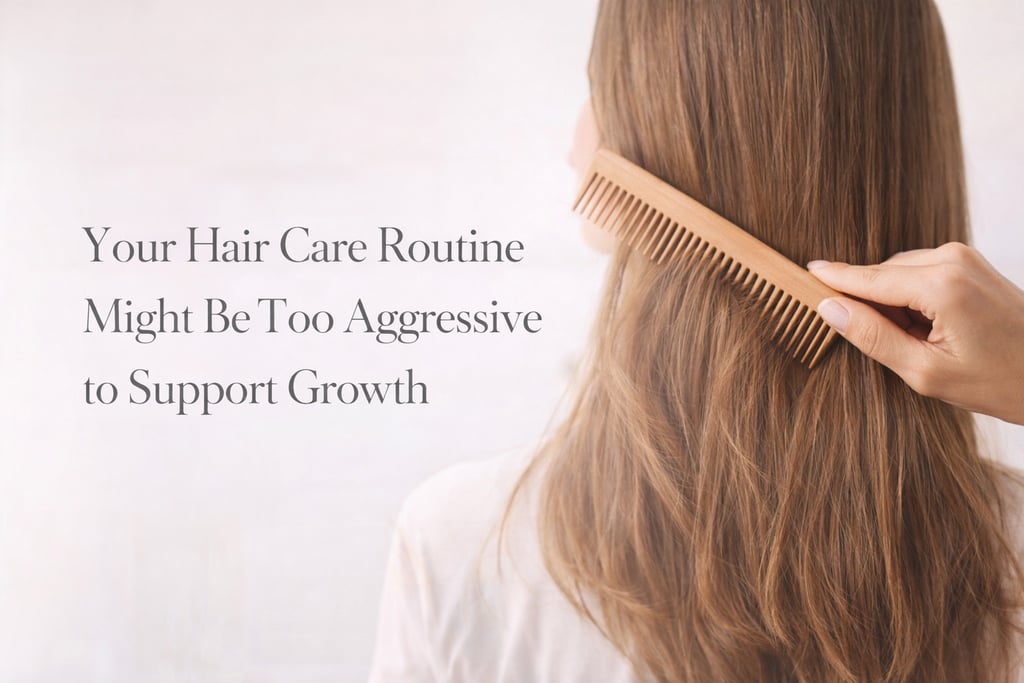
Your Hair Care Routine Might Be Too Aggressive to Support Growth
Hair does not thrive under constant stress. This article explains how overly aggressive hair care routines slow growth and increase breakage over time.
HAIR GROWTH SOLUTIONS
1/8/20263 min read
Why more effort does not equal better hair growth
Many people believe healthy hair growth requires constant attention. Frequent washing. Deep treatments. Styling. Trimming. Oils. Masks.
In reality, too much intervention often causes the opposite effect.
Hair grows best when it is protected and left relatively undisturbed. When routines become aggressive, hair spends more time recovering than growing.
Growth slows when stress becomes part of daily care.
Hair growth happens quietly
Hair growth is slow and steady. It does not respond well to force.
Most follicles grow hair at a fixed rate. Products and techniques can support strength, but they cannot drastically change speed.
What routines can change is how much hair survives long enough to show length.
Aggression reduces survival.
Washing too often weakens hair over time
Clean scalp matters. Overcleansing does not.
Washing too frequently removes protective oils that coat the hair shaft. Without those oils, hair dries out faster and becomes fragile.
Dry hair breaks easily. This leads to the illusion of stalled growth.
Washing should support comfort, not strip protection.
Scrubbing the scalp causes unnecessary stress
Scalp massage can be helpful. Scrubbing is not the same.
Harsh scrubbing irritates the scalp and disrupts follicle health. It also tangles hair near the roots.
Gentle contact is enough. Pressure does not improve results.
The scalp responds better to care than force.
Constant detangling increases breakage
Detangling is necessary. Overdetangling is harmful.
Each pass of a brush or comb creates friction. Repeated friction weakens the hair shaft.
Hair that is constantly styled and reshaped rarely retains length.
Less handling usually leads to stronger ends.
Heat styling accelerates damage quietly
Heat damage does not always show immediately.
Hair may look smooth at first. Damage often appears weeks later as dryness and breakage.
Even moderate heat applied frequently causes cumulative stress.
Reducing heat frequency often improves length retention without adding products.
Tight styles strain hair follicles
Tension based styles stress hair at the root.
Over time, this weakens follicles and increases shedding and breakage. Edges are often affected first.
Discomfort is a warning sign. Pain should not be part of styling.
Comfortable styles protect growth.
Overloading hair with products causes buildup
More products do not equal better results.
Heavy layering creates buildup that blocks moisture from entering the hair shaft.
Hair becomes stiff instead of flexible. This increases snapping.
Clean and light often works better than thick and heavy.
Protein overload makes hair brittle
Protein strengthens hair when used correctly. Too much makes hair stiff.
Brittle hair breaks easily. This often feels confusing because protein is marketed as strengthening.
Balance matters. Hair needs both moisture and structure.
Listening to texture helps guide use.
Protective styles can still cause damage
Protective styles are only protective when they reduce stress.
Styles that are tight, heavy, or worn too long cause friction and tension.
Protection comes from low tension and limited manipulation, not duration.
Breaks between styles matter.
Stress affects hair more than people realize
Stress shifts hair into shedding phases and weakens new growth.
This makes hair feel thinner and more fragile.
Gentle routines are especially important during stressful periods.
Hair often recovers when stress levels decrease.
Why simplifying routines improves growth
Simpler routines reduce friction, tension, and chemical exposure.
Hair spends more time growing and less time recovering.
Consistency becomes easier.
Growth becomes visible when damage slows.
What a supportive routine feels like
Hair feels flexible, not stiff. The scalp feels calm, not irritated.
Shedding is steady but not alarming. Breakage decreases gradually.
Progress feels quiet.
That is usually a good sign.
How long real improvement takes
Hair responds slowly.
Reducing damage today shows results months later.
Patience is required. Constant changes reset progress.
Long term improvement comes from steady care.
Final thoughts
Hair growth does not respond well to aggressive routines.
Protection, gentleness, and patience support length better than constant effort.
When stress is reduced, growth becomes easier to see.